

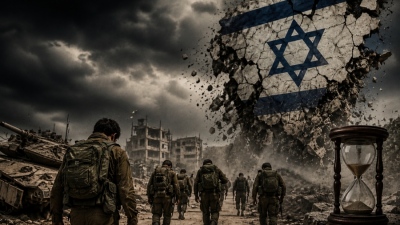
At a time when Israel continues to strike southern Lebanon with particular severity and launch new raids against Palestinian residents in both the West Bank and Gaza, Israeli analysts argue that the fall and collapse of Israel is just a matter of time. In fact, prominent analysts state in their articles in Israeli newspapers that "no miracle" can save the state of Israel anymore, pointing out that the process of disintegration has already begun, drawing comparisons to the Titanic.
The Doomsday
In a recent article, the well-known Israeli General Yitzhak Brik, former Soldiers' Complaints Commissioner of the Israel Defense Forces and one of the most prominent critics of the Netanyahu government and military leadership, published an article in the Israeli newspaper Maariv titled "Doomsday." In this article, he examines the dangerous scenarios facing Israel and warns of an impending state collapse.
Like the... Titanic
Yitzhak Brik compares Israeli society to the Titanic, stressing: "While a large portion of the passengers are drinking, eating, and dancing on the deck, no one seems to perceive the giant iceberg directly ahead of them. A few minutes before the disaster, the passengers of the Titanic were living under the illusion of safety. The same is happening today, as many in Israel choose to close their eyes to reality." "Israel is on the edge of the cliff. Its collapse is closer than ever, and no miracle is going to save it. We must stop relying on false hopes and take action before it is too late," Brik states.
We are not prepared
Specifically, Brik argues that Israel's biggest problem is not a single opponent, but the illusion that the country is better prepared than it actually is. In his view, the political leadership, the top military command, and the military's information mechanism present a picture of success that does not fully correspond to operational reality. Brik essentially says that today the Israeli military is fighting against limited threats. And he stresses that the real test will come when multiple fronts open simultaneously, when there are massive missile attacks, when critical infrastructure is disrupted, when reserves are depleted, and when the entire state apparatus must function under extreme pressure. Then, he says, it will be revealed whether current assurances of readiness were correct or if they hid deeper weaknesses.
Criticism of the military and political leadership
A large part of the article concerns the structural weaknesses of the IDF. According to the Israeli general, ground forces have been weakened in recent years, excessive emphasis was placed on the air force and technology, the capacity to conduct prolonged land warfare was reduced, while he underscores that the training and readiness of reservists are not at the desired level. These are positions he has consistently put forward for years. The political leadership does not escape his fire either. Brik believes that governments prefer to present optimistic pictures instead of confronting difficult problems. In his view, substantial self-criticism is avoided, failures are downplayed, and successes are overemphasized, resulting in the failure to correct actual problems.
We did not achieve the goals in Gaza
Brik argues that the war in Gaza has not achieved its initial strategic goals as they had been presented. As he says, Hamas still possesses significant capabilities, has adapted its way of fighting, operates as a guerrilla force, and notes that the war is wearing Israel down more than the official narrative admits. At this point, he points out that a society becomes vulnerable when it believes it has already won while the problems remain. As he says, optimism can be more dangerous than the opponent itself, because it leads to complacency, and complacency in turn leads to strategic failure.
The multiple threats
In his article, he argues that Israel should not be planning only for Gaza. He believes that in a generalized crisis, several factors could combine: Lebanon, Iran, Syria, Yemen, the West Bank, massive missile attacks, cyberattacks, and severe pressure on the home front. In his opinion, the country has not prepared adequately for such a scenario. For this reason, he addresses the citizens, essentially saying that society must demand greater transparency, not rely solely on official assurances, and push for real reforms before a new major crisis arises. According to Brik, "Doomsday" has not yet arrived. But if Israel does not address the military and political weaknesses he identifies now, then the next major regional conflict will serve as the country's true test. There, in his estimation, it will be shown whether current assurances of strength and readiness were well-founded or overly optimistic.
The Israeli patient
As Israeli military analyst and journalist Avi Ashkenazi states in an article in the newspaper Maariv, "Israel is ruled today by a prime minister, Benjamin Netanyahu, who has lost not only his orientation but also any institutional check that should limit his power." "What has been happening in recent days is nothing less than a sell-off of state institutions, security, and the fundamental values of the state. If the State of Israel were a human being of flesh and blood and not a state entity, it is highly likely that it would have already been rushed to the intensive care unit of a large hospital. Doctors would be fighting to keep him alive, administering resuscitation drugs, treatments to neutralize toxic substances, and foreign aggressive agents destroying his immune system. They would isolate him from his environment to prevent new blows, which could prove fatal for a man on the verge of total collapse of his body's vital functions. But the State of Israel is not a sick person. It is a state entity facing systemic collapse," Ashkenazi points out.
The state
As Ashkenazi says, the country of ten million citizens has operated as a thriving democracy for nearly eighty years, thanks—among other things—to certain fundamental pillars:
• mutual responsibility among all segments of society,
• state institutions,
• the Israel Defense Forces (IDF),
• the Israel Police,
• Shin Bet,
• Mossad,
• the Prison Service,
• an independent judicial system,
• as well as professional, responsible, and reliable media.
Unlimited power in the hands of Netanyahu
According to the article, the government of Israel is currently in the hands of Prime Minister Benjamin Netanyahu, who has lost not only his judgment but also any barrier that should limit the almost unlimited power entrusted to him about four years ago. What is unfolding in recent days in the Knesset, the Israeli parliament, shortly before its dissolution, is nothing less than a sell-off of institutions, national security, and state values. As Ashkenazi says, a single twenty-four-hour period captured the moral bankruptcy of the current government.
They ignore Zamir
As he says, it all started with the bill that equates religious school students with soldiers of the Israel Defense Forces. The government continues to demonstratively ignore the warnings of Chief of the General Staff Eyal Zamir. Member of Parliament Tally Gotliv, who believes that Benjamin Netanyahu is attempting to remove her from the Likud electoral lists because—in his view—she constantly causes political damage to the party, responded to the warnings of the Chief of the General Staff by demanding his immediate dismissal.
The military in decline
Next, Defense Minister Israel Katz brought back to the forefront the case of soldier Elor Azaria, who on March 24, 2016, in the West Bank, had approached a wounded Palestinian and shot him in the head, killing him. A case that had threatened to rupture public trust in the military leadership. A case that damaged the value foundation of the Israel Defense Forces. Despite the opposition of the Chief of the General Staff, the Military Advocate General, and the head of the military's Personnel Directorate, Israel Katz appealed to the President of Israel requesting a pardon for Elor Azaria and the expungement of his criminal record, despite the fact that the latter never accepted responsibility for his actions nor expressed remorse.
The ban on the US
This was followed by the communication trick of Minister of Transport Miri Regev, who decided to clash with the US air force by banning the landing of American aerial refueling aircraft at Ben Gurion Airport. Fortunately, as the Israeli analyst says, the Americans proved to be far more serious than the group of weak ministers ruling from Jerusalem. They reacted immediately, and within about two hours, the airport reopened to the American refueling aircraft participating in military operations against Iran.
Inadequate government
The case of the refueling aircraft at Ben Gurion condenses the entire inadequacy and emptiness of the current government, Ashkenazi stresses. Indeed, the aircraft occupy parking spaces. But today's security conditions are not normal. One would expect the Ministry of Transport, the Civil Aviation Authority, and the Airport Authority to think creatively. For example, Ben Gurion could be temporarily allowed to operate around the clock for the next two months, providing financial incentives to airlines to shift their flights to night hours. Flights to and from Ramon and Haifa airports could also be boosted. But what is easier? To create a communication distraction in the morning. To secure an impressive headline for the internal Likud elections.
Fire from within
A few hours later, it was the turn of Defense Minister Israel Katz, who attacked the Minister of Finance and the Ministry of Finance for not approving the funding of the most important—as he said—item in the state budget: that for the rehabilitation of wounded soldiers of the Israel Defense Forces. And as if all this were not enough, it was followed by what the columnist describes as the government's anti-Zionist vote, which granted immunity from arrest to IDF deserters. The most worrying element of Israel's deepening crisis is that the Knesset continues to sit until Friday. And even more worrying is that the internal Likud elections have not yet taken place. No one knows how far the candidates are willing to go, worsening Israel's situation even further—in terms of security, values, and potentially causing irreparable damage to the Israel Defense Forces and the country's other security mechanisms. "There are moments when you watch live what is happening before your eyes and realize that the entire structure that has been built is collapsing, disintegrating, and turning into a pile of ruins," Ashkenazi underscores.
The beginning of the collapse
He argues that what is happening in the final days of the 25th Knesset constitutes the beginning of the collapse of Israel and that this assessment is not an exaggeration. As he notes, the problem is not limited to the warning letter sent two days ago by Chief of the General Staff Eyal Zamir to the prime minister and the defense minister, nor exclusively to the operational burden borne by the Israel Defense Forces. "The matter is much deeper and much more complex," stresses Avi Ashkenazi, who also mentions that Israel was founded under conditions of generalized collapse and that David Ben-Gurion managed then to defuse the internal conflicts of Israeli society, creating a unified state, a unified army, as well as unified judicial, police, and state institutions. In his view, however, David Ben-Gurion's great mistake was that he did not establish a comprehensive Constitution and, instead, granted special status to ultra-Orthodox Jews (Haredi), exempting them from a series of obligations, even from military service.
Military structure as the foundation
The Israeli military analyst points out that the state of Israel was built upon its military structure. According to him, the purpose of creating the army was the unification of Jewish immigrants, the reduction of social differences, and the formation of a common Israeli identity. The ideology of the Israeli army, he adds, was the protection of the entire Jewish people, and that is why Jews treated the army with the same respect they pay to the stones of the Western Wall (Wailing Wall). Avi Ashkenazi underlines that in the past, those who were not accepted into the army felt shame before society.
Exemption from service
However, in recent years, due to political changes, a new reality has emerged, where an entire segment of the population—about 18% of Israel's residents—demands to be exempted from any obligation of military service. He estimates that the decisions of the Israeli government regarding military service legislation pave the way for the disintegration of the army. Using a characteristic metaphor, he argues that the government "left the stable door open and invited the horses to escape." Consequently, he notes, the question is no longer when or where someone will serve their military service, but whether it is worth serving at all and to what extent it makes sense for Israelis to enlist in the military.
A matter of time... the collapse
Avi Ashkenazi concludes that the government itself, through its choices, has begun to dismantle the foundations of the Israeli state and that its collapse and transformation into ruins is now simply a matter of time. The article also points out that in recent years—and especially during the recent period—political power in Israel has completely dominated the military apparatus. The columnist warns that when the military proves incapable of fulfilling its mission, then the true scale of the crisis will be realized. "But by then it will already be too late, because the entire structure of Israel will have collapsed," he characteristically notes.
www.bankingnews.gr






Σχόλια αναγνωστών